Another Guiteras breakdown can no longer be presented as an isolated accident
The country’s main thermoelectric plant leaving the grid again exposes a power system with no margin, where every failure becomes additional hours without electricity.
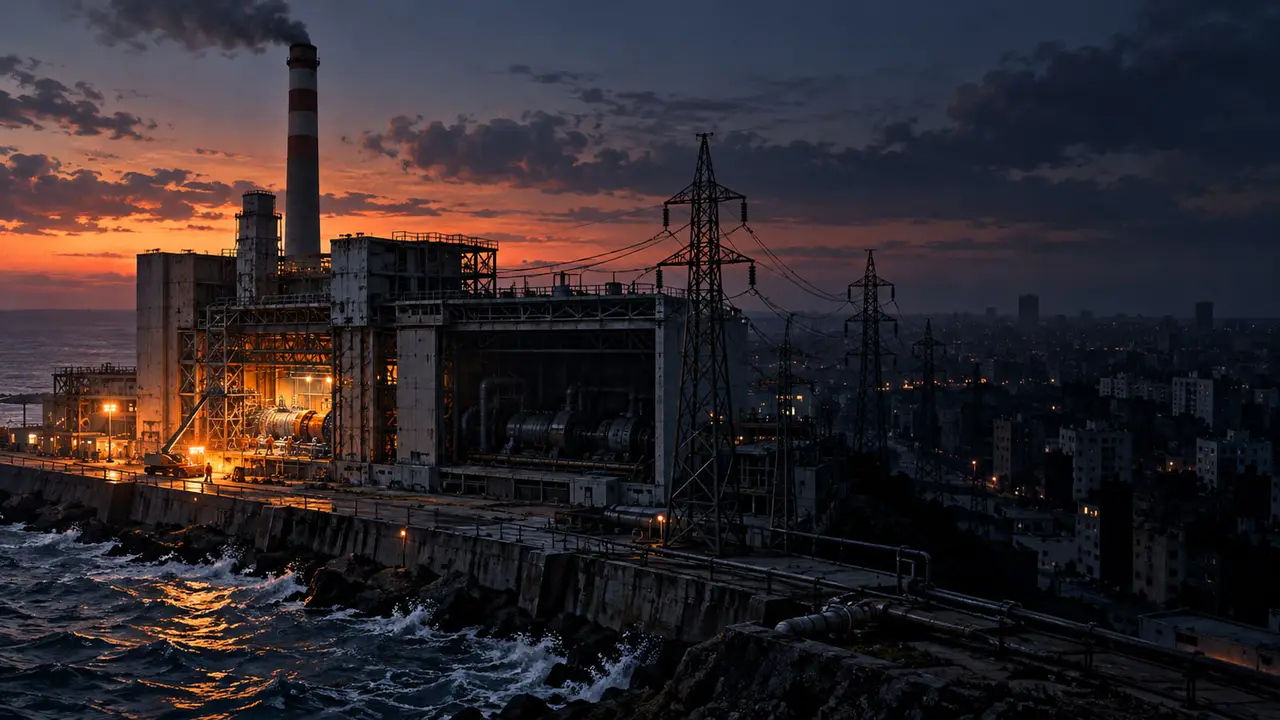
The Antonio Guiteras Thermoelectric Plant left the grid because of a leak in the economizer, known as the ECO, but this did not happen in a system with spare capacity. Cuba’s Electric Union forecast 1,914 megawatts of disrupted service for Wednesday night while the country was already carrying outages throughout the previous day and early morning. The breakdown is confirmed; the final reach of the blackout was still a forecast.
The report placed morning availability at 1,026 MW against demand of 2,298 MW, with 1,286 MW of service affected. It estimated up to 1,400 MW affected during the day. For the evening peak, it projected demand of 2,910 MW and a deficit of 1,884 MW, with 1,914 MW of expected disruption. Those are different figures: a deficit and interrupted service should not be treated as the same measure.
The ratio between projected disruption and peak demand gives a measure of the imbalance, but it does not establish that an identical share of households will lose power. Outages are distributed by circuit and schedule, and the available information does not identify which territories would face the longest cuts. For each family, the national forecast is therefore no substitute for a reliable local schedule.
Guiteras is not just another unit in this equation: its outage removes major capacity when reserves are scarce. Reviewed reports describe a series of disconnections during 2026 and say the economizer has repeatedly been involved in failures. One report says the component has operated for 38 years and has not received a major overhaul since 2010. That record makes the latest episode difficult to view as an isolated surprise.
The latest failure came only days after another outage attributed to a leak in a steam temperature-control line. They are different faults, and their proximity does not by itself prove a single cause, but it raises a question about the stability of the unit’s return. Reconnecting a plant to the national grid is not the same as ensuring that it can sustain generation for an extended period.
Pressure on the system does not come only from Guiteras. The cited report listed breakdowns at Felton and Renté and maintenance work at units in Santa Cruz, Nuevitas and Renté. It also reported that solar parks supplied 4,697 MWh the previous day and reached maximum output of 730 MW. That contribution helps during daylight hours but does not automatically replace capacity during the evening peak.
For households, the practical consequence is another day of uncertainty: cooking, preserving food, studying and resting depend on schedules that can change when a unit fails. Small businesses and other services also need to know how long interruptions will last. National figures show the scale of the problem, but the information provided no repair deadline for Guiteras or confirmed time for its return.
The public response should not be limited to updating the number of affected megawatts each night. Authorities need to explain what was found in the economizer, what repair will be performed, how much power the unit can deliver when it returns and how uncertain the schedule remains. The priorities for maintenance and alternatives while several plants remain unavailable also need to be made public. Without those details, the breakdown is confirmed but the ability to anticipate the next contingency remains opaque.