Individual contracts alone do not free Cuban doctors
Jamaica brought back 157 professionals under direct agreements, but the new model's independence can be demonstrated only through full wages, freedom of movement and absence of coercion.
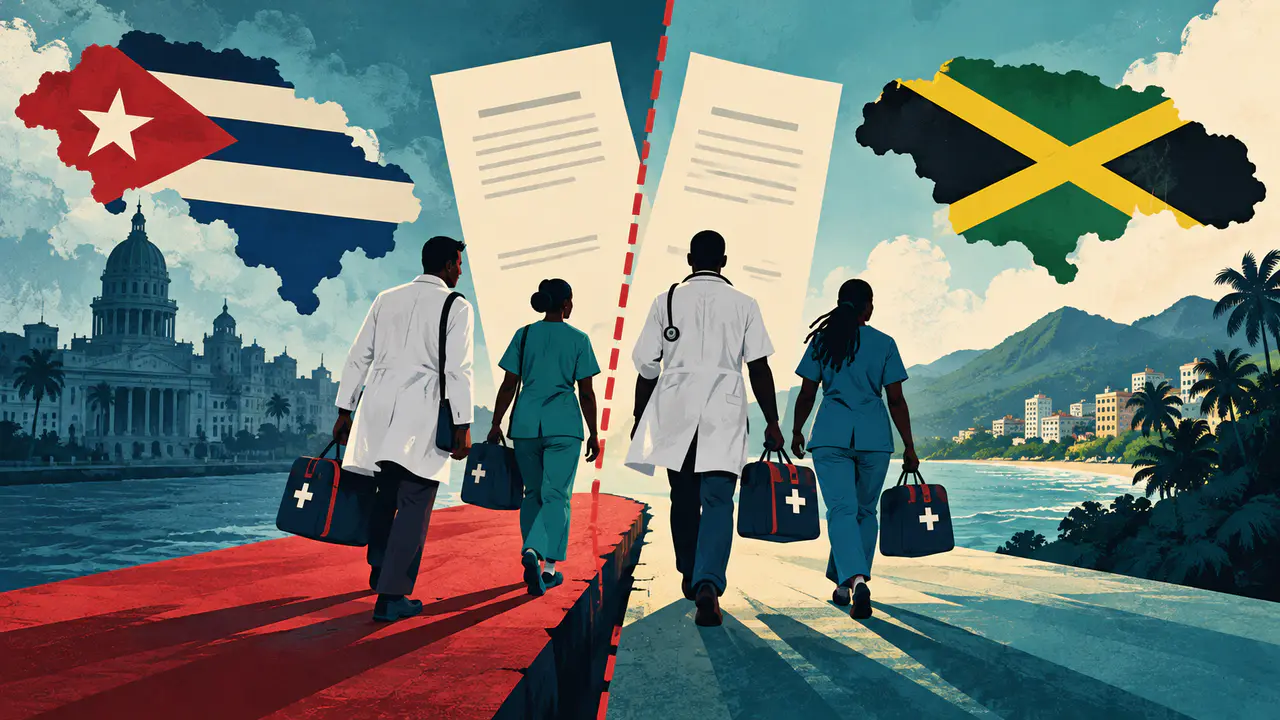
Jamaica reported that 157 Cuban health professionals returned to the public system under individual contracts. Together with 43 who remained after the bilateral agreement ended, the group totals 200. Direct hiring changes the formal mechanism but does not by itself establish actual employment conditions.
Jamaican Health Minister Christopher Tufton announced the figures in October. Workers were assigned across different areas and institutions: 69 in the southeast, 28 in the west, 26 in the south, 25 at the University Hospital of the West Indies, and nine across the northeast and Health Ministry. Those figures describe announced assignments, not individual conditions at each position.
The change followed Jamaica's termination in March 2026 of the bilateral agreement, which had not been renewed after the previous arrangement expired in February 2023. Kingston left open the possibility of hiring health professionals under its labor laws. The Cuban government attributed the break to U.S. pressure, while Jamaica raised objections to the previous mechanism.
In its review of the previous program, Jamaican authorities said many professionals did not hold their own passports and that agreed wages were transferred in dollars to Cuban authorities. According to Kingston, workers directly received only overtime payments. The government also said it found no problems with housing, permits or freedom of movement in Jamaica.
That background explains why payment arrangements and document control are central to evaluating the new model. Jamaican authorities questioned the earlier agreement's failure to specify how much of transferred wages reached each worker. But review of the old system does not automatically prove that the same conditions remain under individual contracts.
The minister said professionals could decide whether to return and accept individual contracts. Julio César Alfonso, president of Solidarity Without Borders, questioned the agreements' effective independence and suggested Havana could retain influence over doctors and their income. That is a concern attributed to a critic, not a finding about every one of the 157 workers.
Available information does not include the full new contracts or individual salaries. Without those documents, it is impossible to determine how much each professional receives, which deductions may apply, or how much freedom they have to resign or change jobs. Direct hiring is a verifiable formal change, but guarantees require more evidence about implementation.
Jamaica also needs health workers and acknowledged vacancies after the agreement ended. Defending transparent labor conditions does not mean rejecting Cuban professionals; it means requiring comparable rights with other foreign workers and compliance with local law. The need to fill positions does not remove the obligation to clarify who pays and who receives the money.
The new arrangement will be tested by verifiable outcomes: each worker controlling personal documents, knowing the terms, receiving the agreed pay directly and deciding about employment without coercion. Until those data are published, the figure of 200 describes staff returning but does not answer how much the labor relationship changed in practice.