A dollar at 850 pesos is more than a record: it is the price of living without a reliable currency
The informal benchmark closed October 27 at 850 CUP per dollar. The figure is neither an official rate nor a guaranteed price, but it portrays the loss of trust running through Cuba's economy.
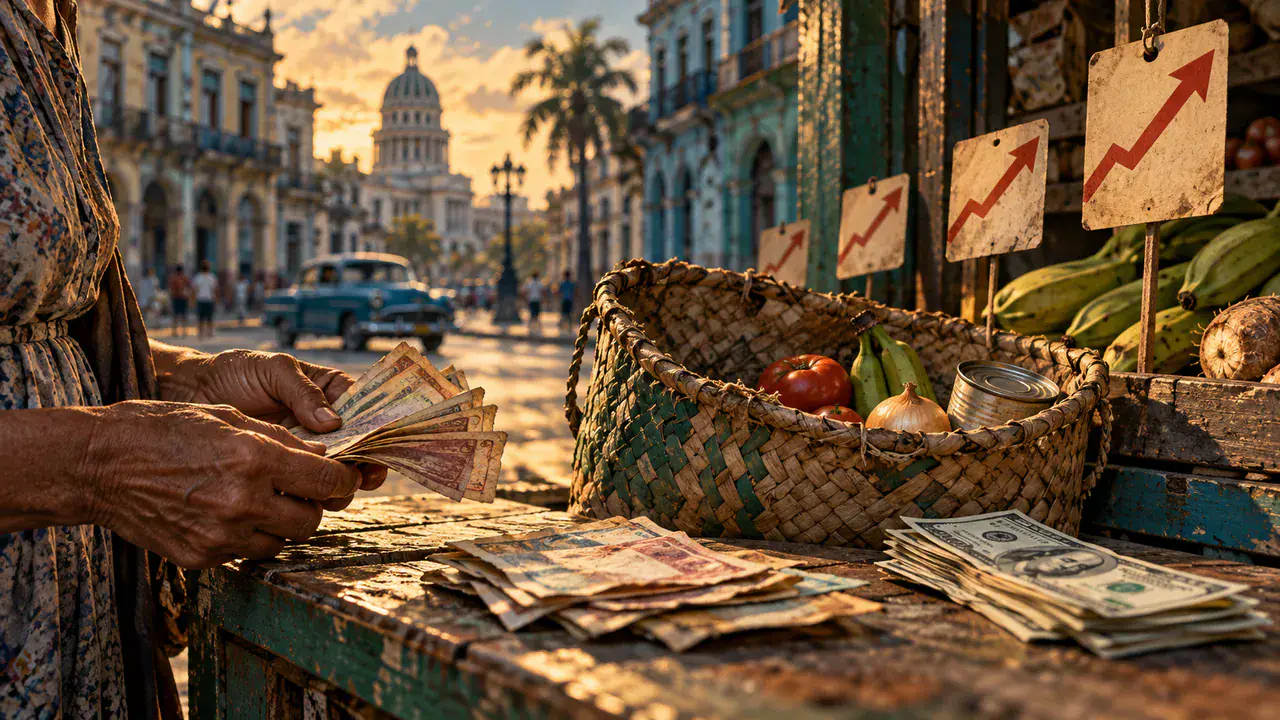
The dollar closed October 27 at 850 Cuban pesos in the informal-market index tracked by CiberCuba. Hours earlier, Directorio Cubano had cited an elTOQUE reference of 845 CUP. The difference is not a contradiction: the measurements were taken at different moments in a volatile day. Neither is an official rate, a promise to buy or the single price of every transaction. They are references built from advertisements and signals in a fragmented market.
That precision matters because a spectacular figure can easily become a misleading headline. Cuba's informal market has no central counter where everyone buys and sells at the same price. Prices vary by location, urgency, amount, payment method and trust between the parties. Indexes try to organize that noise, discard atypical messages and provide a representative measure. They are useful for observing the trend; they do not replace the concrete reality of each transaction.
But the methodological nuance does not lessen the movement's seriousness. On the contrary, different references agreeing on an upward trajectory indicates that the peso continues losing its capacity to serve as a store of value. When a family is paid in national currency but calculates food, medicine, transportation, mobile credit or leaving the country in dollars, the salary ceases to be a stable measure. Each rise in foreign currency shortens the time income retains purchasing power.
The gap also exposes the limits of the official exchange market. On October 27, CiberCuba placed the Central Bank's Segment III rate at 749 CUP per dollar, 101 pesos below the informal close of 850. A lower official rate benefits citizens only if they can actually obtain foreign currency in sufficient amounts and predictably. When supply does not meet demand, the effective price moves toward informal channels.
There is no single cause. Falling production, scarce goods, the fiscal deficit, monetary issuance, partial dollarization, demand from private importers and uncertainty all matter. External restrictions, the cost of moving money and many families' need to finance travel or help relatives also have an effect. Reducing the entire phenomenon to speculation by one platform—or, at the opposite extreme, attributing it solely to U.S. sanctions—prevents an explanation of why people seek refuge in a foreign currency.
Dollarization also deepens an already visible inequality. Those receiving remittances or billing in foreign currency can better protect part of their consumption. Those relying on a salary or pension in CUP absorb the loss. The same increase that raises a remittance's value in pesos makes products incorporating import costs harder to obtain. Relief for one household can become pressure on another.
The 850 record should therefore not be read as a financial curiosity. It is an imperfect but useful gauge of confidence. A currency is sustained not only by decree but because recipients believe it will buy roughly the same tomorrow as it does today. When that expectation disappears, people and businesses adjust prices, bring purchases forward or convert savings, feeding the very cycle they fear.
The public response cannot be limited to pursuing uncomfortable reference rates or opening exchange-market segments without enough supply. Restoring stability requires producing more, organizing public finances, making rules transparent, expanding legal access to foreign currency and reducing arbitrariness around economic activity. No informal index can substitute for those reforms. Until they arrive, however, ignoring its signals will not make the peso reliable again.