Sanctions on BICSA further narrow Cuba’s financial channels
Washington links the state bank to services for Iran’s Karafarin since 2022; the measure requires concrete details and an assessment of costs for legitimate payments.
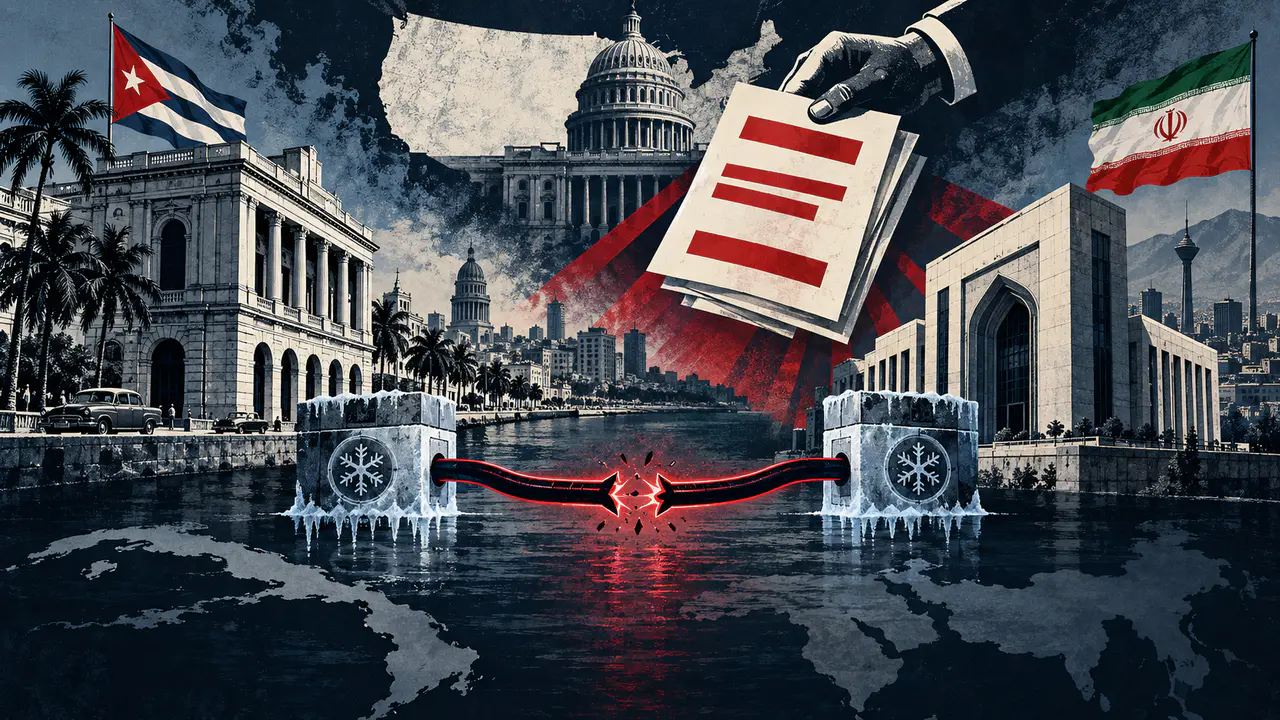
The United States sanctioned Cuba’s International Trade Bank, known as BICSA, over financial services that, according to the U.S. announcement, it provided to Iran’s Karafarin Bank since at least 2022. Secretary of State Marco Rubio announced the decision on October 15, 2026. BICSA is a Cuban state entity; the stated basis is its relationship with the Iranian bank, not a public account of every specific transaction.
The attribution must retain its source: Washington is the party linking BICSA’s services to Karafarin and using that relationship as the basis for the sanction. Available information does not detail accounts, transfers, amounts, beneficiaries or the precise nature of the services. Without those details, outside observers cannot measure the scale of the operations or assess which specific transactions led to the action.
The timeline also requires precision. The announcement places the questioned services as beginning at least in 2022, language that establishes an approximate starting boundary rather than an exact date. The sanction was announced in October 2026. The material identifies the financial relationship as the reason but does not provide a transaction-by-transaction chronology or a detailed BICSA response that would allow the allegation to be compared with the bank’s account.
The regulatory consequence includes a deadline set by the U.S. Treasury Department’s Office of Foreign Assets Control, or OFAC, through November 14, 2026, for foreign persons to wind down existing operations with BICSA. The clarification identified as FAQ 1276 neither lifts the sanctions nor authorizes ordinary commercial operations to continue. The wind-down period therefore should not be confused with a general license to keep doing business with the bank.
The clarification also distinguishes foreign persons from those under U.S. jurisdiction: the existing prohibitions for the latter do not disappear during the wind-down period. That distinction makes it essential to identify who participates in a transaction, where that person is located and which rules apply. The information provided does not support a conclusion that every payment, contract or connection involving BICSA receives identical treatment.
For companies and banks that handle international payments, the sanction may prompt reviews of counterparties, contracts and settlement channels. That is a practical risk, not proof that every legitimate operation has been blocked. Financial institutions may adopt precautions broader than those explicitly required, but the available material does not quantify cancellations, added costs or disruptions already experienced in Cuban trade.
The breadth of the effects will depend on the details made public and on how banks, suppliers and operators interpret the rule. If affected transactions are not clearly defined, parties that did not take part in the cited conduct may choose to avoid any associated operation. Some relationships may also have to close before the deadline because of other applicable restrictions; the calendar does not guarantee that every participant has the same option.
A Cuban response and the bank’s financial records are still needed for a fuller picture. The reviewed coverage does not include a detailed BICSA reply or statements, audits or records of the cited operations. That absence does not invalidate the U.S. measure, but it limits public testing of its basis and assessment of whether the consequences are proportionate to the alleged conduct.
The analysis should remain focused on what is known and what is missing: a sanction was announced, Washington attributed a financial link, and certain operations involving foreign persons received a wind-down deadline. The material does not identify the precise transactions or damage already caused to legitimate payments. Publishing those details and clarifying permitted channels would help target the questioned operations without unnecessarily extending uncertainty throughout Cuba’s financial system.