The $809.6 million that demands precision when discussing the embargo
The United States exported $809.6 million in goods to Cuba in 2025. The figure neither erases sanctions nor absolves the Cuban government: it dismantles the easy claim that no trade exists between the two countries.
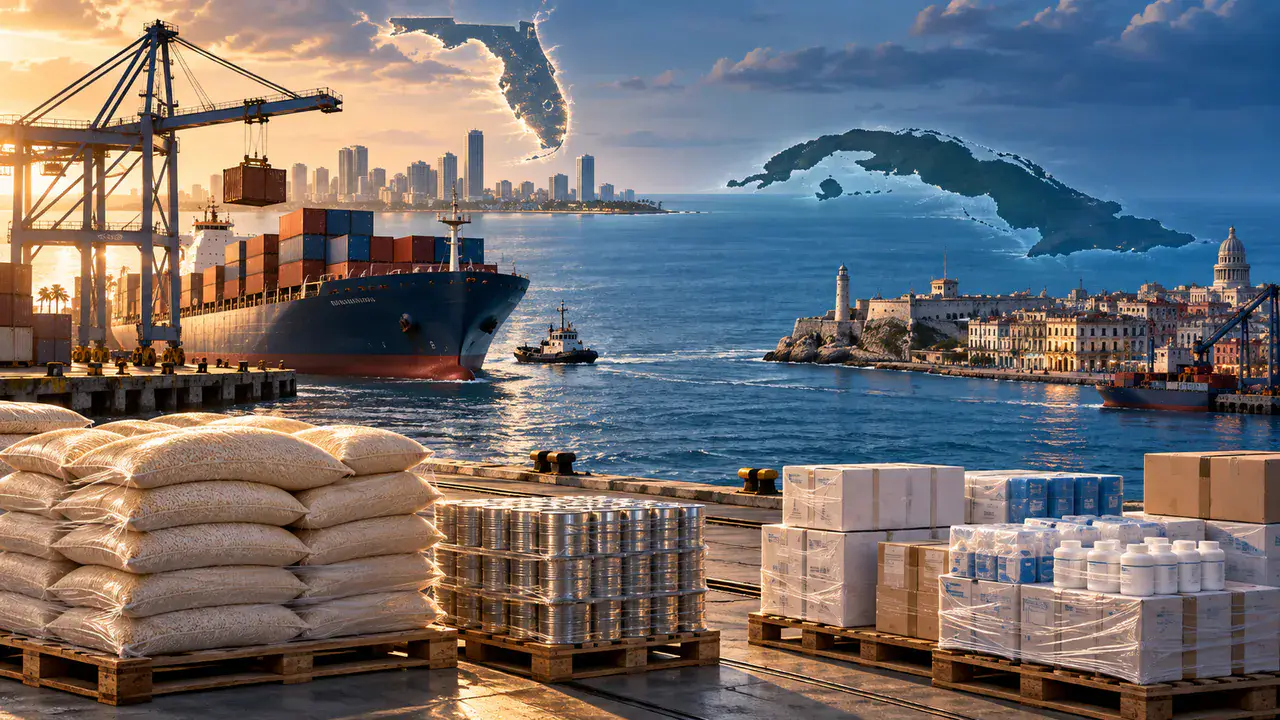
The figure is official and deserves to be read in full: the United States exported $809.6 million in goods to Cuba in 2025, a 38.3 percent increase from the previous year, according to the Office of the United States Trade Representative. In the other direction, U.S. imports from the island totaled $17.5 million. The result was a goods surplus of about $792 million for the United States.
The figure resurfaced in Cuban media coverage on October 27 amid the annual debate over sanctions policy. Its value lies not in offering a new slogan but in forcing two claims that are incompatible with reality to be abandoned. The first is that the embargo amounts to an absolute commercial shutdown. The second is that the existence of exports proves sanctions have no effects. Neither survives serious scrutiny.
The imbalance also deserves attention. Cuba bought far more than it managed to sell to the U.S. market. That disparity does not describe a normal or diversified trade relationship: it shows a channel concentrated in licensed transactions and sustained by Cuba's need to import. A large absolute figure can coexist with insufficient supply on the island and few opportunities for Cuban producers to enter the neighboring market.
The embargo remains in force and prohibits or conditions numerous transactions, investments and services. Yet the U.S. framework contains licenses and exceptions, particularly for agricultural products, food, medicine, medical devices and certain humanitarian operations. Broad restrictions can therefore coexist with trade flows worth hundreds of millions of dollars. The word embargo describes a legal architecture; it does not mean every sack of food or piece of medical equipment is blocked.
Another simplification also needs correction. The $809.6 million is the total value of goods exported in 2025. It should not automatically be presented as though every dollar consisted exclusively of food or medicine without reviewing the customs breakdown. What the USTR and Census Bureau statistics firmly support is the total scale of trade and its strong imbalance in favor of the United States.
For the Cuban government, sanctions are the central explanation for shortages and the crisis. In parts of Miami's political discourse, every shortage is attributed solely to inefficiency and state control. The data show a more uncomfortable picture. Cuba can buy certain U.S. goods, but it needs foreign currency, credit, logistics and domestic import decisions. At the same time, financial restrictions and regulatory risk make operations costlier, drive banks away and reduce investment and payment options.
Nothing in that $809.6 million guarantees that a product will become available or affordable to a Cuban family. Between the port of origin and the store counter stand the state or private buyer, transportation costs, margins, taxes, distribution and access to currency. Permission to export does not solve low domestic production or consumers' lack of income. Nor does it eliminate obstacles imposed by the sanctions system on other areas of the economy.
The figure should therefore be used to absolve neither Washington nor Havana. It serves to demand more precise accountability. The United States must explain the concrete objective of each restriction and how it avoids harming the population. The Cuban government must publish what it buys, at what price, who distributes it and why a country importing hundreds of millions of dollars in goods still does not guarantee essential food and medicine.
Discussing the embargo rigorously means acknowledging permitted trade and real barriers at the same time. It means separating a customs statistic from a promise of well-being and a legal exception from a normalized market. The $809.6 million does not make the embargo disappear. It does, however, make the excuse of debating it without figures disappear.