A solitary protest reveals the cost of dissent in Cuba
The detention of Pastor Ariel Limias Leiva outside the Capitol turns two signs and one solitary voice into a test of freedom, due process, and family vulnerability.
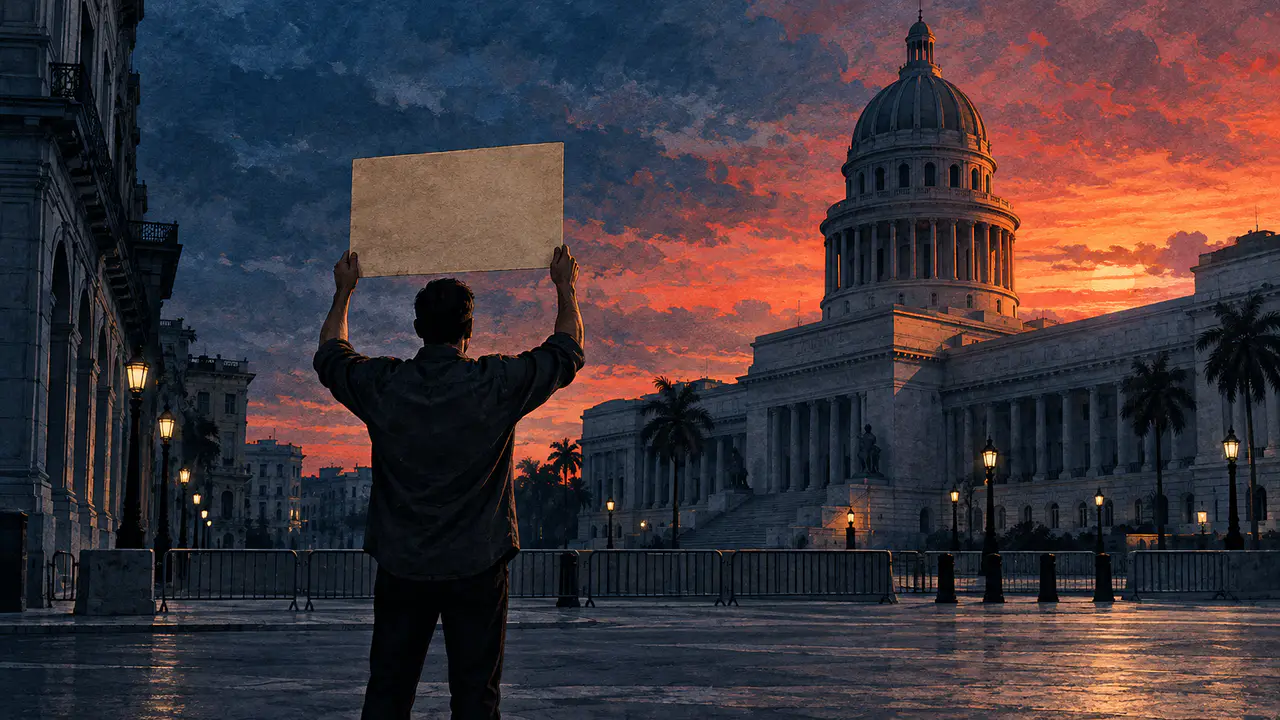
Ariel Limias Leiva’s protest outside the Capitol was solitary and brief, but its consequences extended far beyond the site. The 53-year-old Pentecostal pastor was detained on October 2 after displaying a sign with messages against dictatorship and political discrimination. Reports place the beginning of his route on Monte Street and his detention on the building’s steps.
After the arrest, Limias was first taken to the Dragones police station and then transferred to Villa Marista in Havana. His family reported that he remained incommunicado and under investigation. In a later update, his wife, Yulia Morales Zamora, said they had learned the alleged offense: propaganda against the constitutional order. The available information does not describe a separate formal charge or his subsequent procedural status.
The progression of the reports matters because relatives initially had no precise information about the allegations and later said they had been told the applicable offense. Morales and other family members went to Villa Marista to seek information and deliver toiletries, but they were unable to see him during those visits. The initial uncertainty is a fact of the case, not by itself proof of how the proceedings will end.
According to published accounts, the family did receive medical information through a doctor: the pastor was stable, his blood pressure was under control, and he was receiving his medication. Morales also said that her husband suffered a heart attack in January and needs cardiac treatment. That history makes sustained verification of his access to care especially important, without treating assurances about his condition as an independent assessment.
Reports said the family expected a hygiene visit on October 9. At the time of the information consulted, that visit was still in the future, so it should not be described as having taken place. Relatives were also reported to be seeking legal representation. His location, contact with counsel, and the progress of the case file are practical matters that still require confirmation.
The offense attributed to him has been questioned by Cubalex, an organization cited in the reports. According to its analysis, the offense of propaganda against the constitutional order uses broad terms and does not define with sufficient clarity which acts or content it may cover. That criticism is not equivalent to a judicial ruling in this case, but it raises a specific concern about the law’s predictability.
The central question, then, is not limited to whether the state may regulate public space. It also requires knowing what specific conduct supports the allegation and how political expression is distinguished from what the law criminalizes. The available information describes a sign bearing critical slogans, but it does not include the case file, a detailed official account, or the defense’s arguments.
Limias had previously taken to the streets in Havana in July 2021 with a sign reading “Freedom”; according to the sources, he was detained and later fined. That history shows this is not his first detention connected to a public demonstration, although it is not enough by itself to establish a general policy or predict the outcome of the current case.
Follow-up should focus on verifiable facts: whether the announced visit takes place, whether the defense gains access to the file, and what decision the authorities make about the investigation. When a person is detained and held incommunicado, information about health, location, and procedural safeguards is not a secondary detail: it allows the family and the public to evaluate how criminal power is exercised in response to dissent.