Orlando Manrufo and Mariconchi: the humor that turned a theater into a neighborhood conversation
The Cuban actor's death, confirmed on November 4 by the Center for the Promotion of Humor, closes a career tied for nearly three decades to a character who outlived fashions and formats. More than a farewell, his story helps explain why popular comedy also forms part of Cuba's cultural memory.
A confirmed death and several questions still unanswered
The Center for the Promotion of Humor confirmed Wednesday the death of Orlando Manrufo Cordova, known for playing Mariconchi. The institution remembered the irreverent elderly woman who for years starred in Mariconchi's Corner at Havana's Teatro America.
At publication time, the cause, place and circumstances of his death had not been officially reported. That absence of detail requires separating the confirmed fact from versions that may circulate: the artist died; everything else must await a statement from his family or cultural institutions.
The news prompted farewell messages from colleagues, including Luis Silva. The immediate response shows that Manrufo was more than the performer behind a recognizable character. He belonged to a generation of comedians who made the stage a meeting point for very different audiences.
Mariconchi was more than a wig and a voice
Mariconchi appeared as a foul-mouthed, quarrelsome older woman, but the character's power did not rest solely on the costume. She worked because she spoke in codes familiar to Cuban audiences: the quick retort, exaggeration, the uncomfortable observation and the ability to turn an everyday hardship into a shared scene.
Accounts of his career trace the character's origins to the 1990s and connect her stage development to artistic director Ricardo Isidron. With The Adventures and Misadventures of Mariconchi, Manrufo received an Aquelarre Award, one of Cuban stage comedy's leading honors.
The award, however, explains less than the character's staying power. For years, Mariconchi's Corner filled Teatro America and built a direct relationship with spectators. It was not a closed performance that could be repeated identically: much of its appeal lay in the exchange with the audience and the possibility that any reaction from the house could become comic material.
The cultural value of laughter that does not erase reality
Popular comedy often receives less critical attention than other artistic expressions. It is measured by immediate laughter and not always by the memory it leaves behind. Characters such as Mariconchi, however, preserve gestures, phrases, ways of speaking and social tensions that also tell the story of an era.
In Cuba, where daily life has been marked by shortages, bureaucracy and constant change, humor has served as relief but also as a form of observation. Laughter does not eliminate the problem. Sometimes it makes it possible to name that problem without turning every conversation into a solemn speech.
Manrufo defended a style that sought complicity rather than aggression. That choice matters at a time when much comedy circulates in short clips, depends on immediate provocation and can confuse humiliation with humor.
Mariconchi operated from a different place: audiences recognized the character, but they also recognized in her ways of reacting that they had seen within their families, neighborhoods or the line outside any store.
A body of work that deserves preservation
An artist's death creates a responsibility that does not end with condolences. Cuba needs to preserve recordings, photographs, interviews, scripts and testimony from its stage performers. Much of that memory remains scattered across personal archives, old broadcasts and publications that are difficult to locate.
Preserving Manrufo's work does not mean freezing Mariconchi as a museum piece. It means allowing new generations to understand how a character capable of sustaining a conversation with her audience for decades was built.
It also means recognizing the directors, technicians, musicians, actors and theater workers who made each performance possible. A popular character is never created entirely alone.
The stage is empty, but the conversation continues
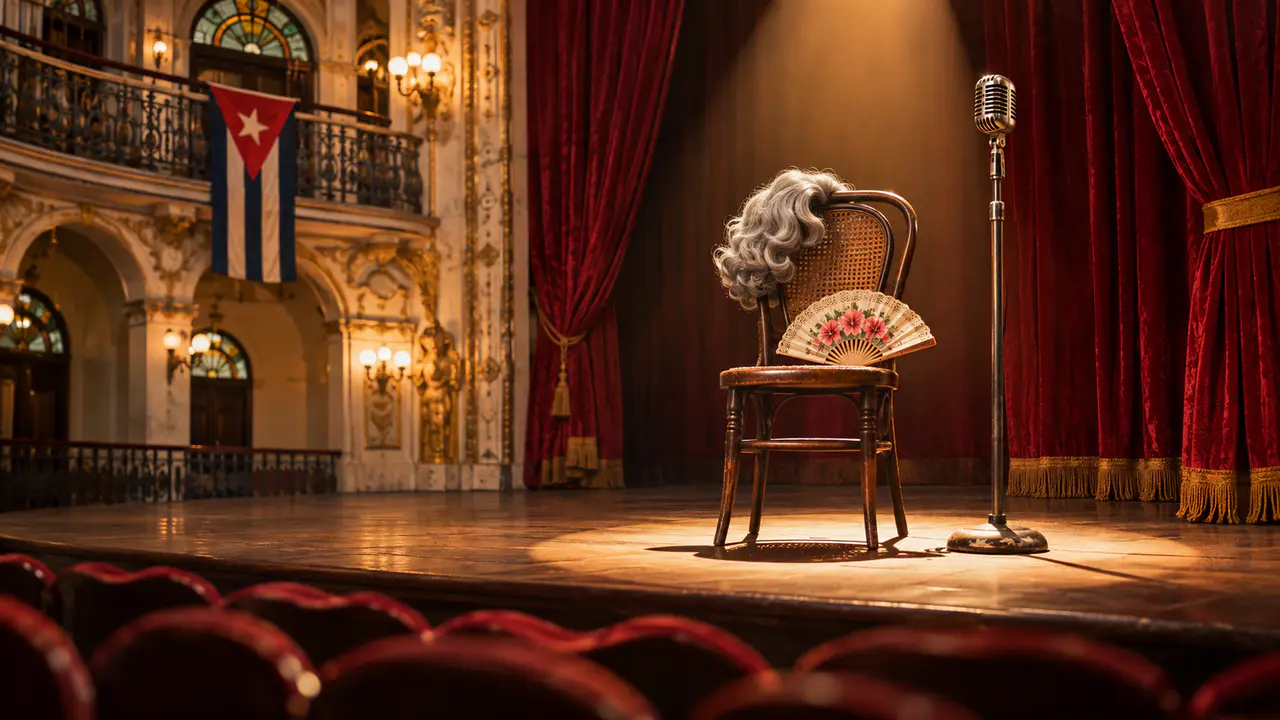
The image of an empty seat may suggest an ending. In Orlando Manrufo's case, it describes only the performer's physical absence. Mariconchi will continue to appear in the memories of those who saw her on stage, in family stories and in whatever recordings can be recovered.
The best farewell is not to turn the artist into a figure without nuance, but to return to his work, document it and discuss why it endured.
Orlando Manrufo made a fictional old woman a recognizable presence for several generations. That ability to transform a stage into a neighborhood conversation is part of his legacy and, since November 4, also a task of remembrance for Cuban culture.
This article was prepared with information published on November 4, 2026. The cause and circumstances of the death had not been officially disclosed at publication time.