Belize changes the rules for Cuban doctors: from a state agreement to individual contracts
The Belizean government will not renew the health agreement signed with Cuba in 1990, but it will offer direct contracts to the 92 Cuban professionals working in its public system. The decision seeks to protect medical care while bringing a pending question to the forefront: who controls each worker's salary and working conditions?
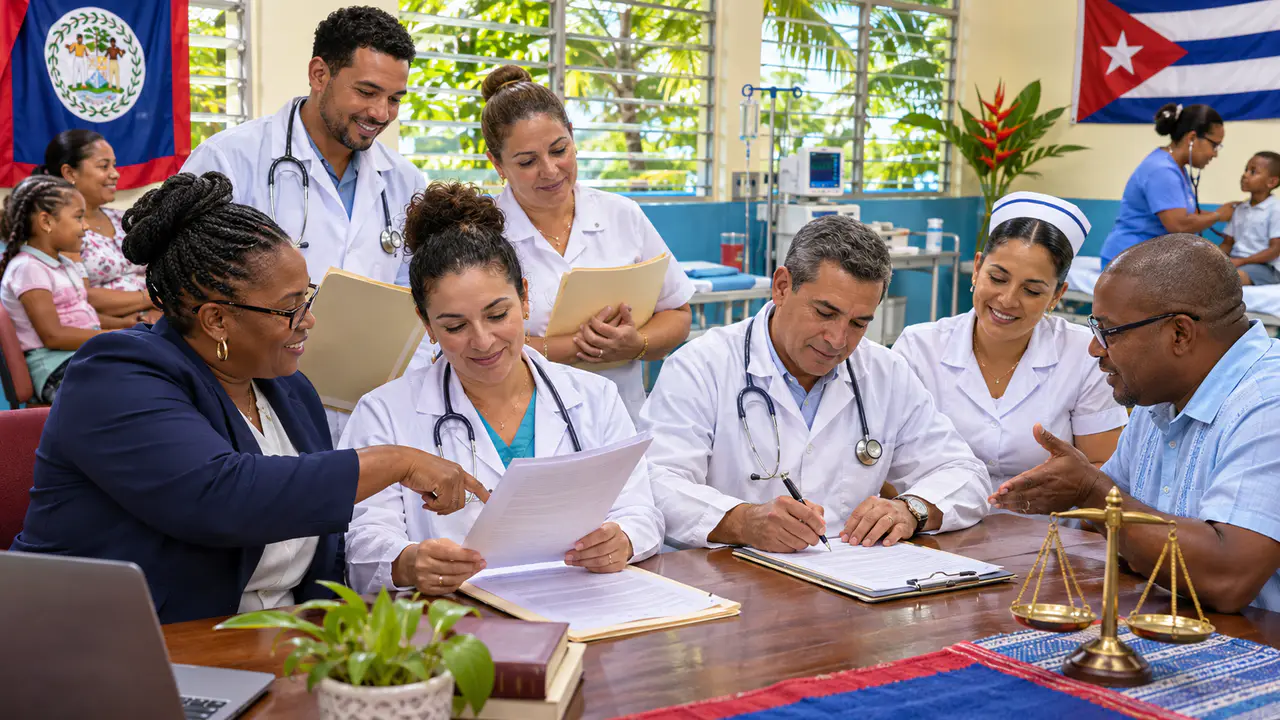
A 36-year agreement ends, but not necessarily the Cuban presence
Belize announced that it will not renew the agreement under which members of Cuba's medical brigade have provided services in the country since 1990. The change does not amount to an automatic expulsion or the closure of clinics staffed by those professionals.
The Ministry of Health and Wellness plans to sign individual contracts with those who choose to remain. The mission includes approximately 92 health workers; 45 are physicians, while the rest are nurses, technicians and other specialists, according to figures released by Belizean authorities.
The central fact is therefore twofold: intergovernmental mediation through the agreement is ending, but Belize wants to retain the professional capacity that currently supports part of its public health network.
Continuity of care explains the transition
Belize's health system faces staffing shortages, particularly outside the main urban centers. In the Toledo District, eight of the 16 available doctors were Cuban, according to reports cited during the negotiations.
An immediate withdrawal would have created a gap that would be difficult to fill. Direct hiring offers a transitional formula: it prevents a political or contractual disagreement from abruptly turning into canceled consultations, uncovered shifts or rural communities without care.
That principle deserves emphasis. Debates about medical missions tend to focus on the governments of Cuba, the United States and the receiving countries. Patients, however, need continuity. Any responsible change must begin by ensuring that a diplomatic dispute does not interrupt treatment or worsen the shortage of professionals.
A direct contract does not automatically mean transparency
The new arrangement could give each professional a clearer employment relationship with the institution receiving their work. Its value, however, will depend on the specific terms.
At publication time, salaries, benefits, schedules, immigration permits, complaint procedures and guarantees concerning workers' possession of their personal documents had not been detailed. It was also unknown how many members of the brigade would accept the contracts.
Those questions are not secondary formalities. They determine whether the change offers genuine autonomy or merely replaces the name of the agreement while external controls over workers' compensation and mobility remain in place.
An individual contract should be available to the professional before signing, written in a language they understand and governed by Belizean labor law. It should specify how much the worker will receive, what deductions will apply, who covers housing and transportation, how the relationship can be terminated and what channels are available to report abuse.
Between pressure from Washington and Havana's defense
The decision comes amid a regional review of Cuba's medical agreements. The United States has described those programs as exploitative arrangements and has pressed governments to examine the withholding of salaries and participants' working conditions.
Havana rejects that characterization and maintains that the brigades are a form of cooperation that brings health personnel to places with urgent needs. For Cuba, the export of professional services is also an important source of revenue.
The two positions are often presented as absolutes, but the Belize case makes it possible to evaluate concrete facts. The country acknowledges that it needs Cuban doctors while abandoning the state agreement in favor of hiring people individually.
The quality of the outcome will not be measured by who wins the political dispute, but by three verifiable indicators: continuity for patients, freedom of choice for professionals and transparency about where the money goes.
An opportunity that must be open to scrutiny
Belize can turn this transition into a regional standard by publishing the basic elements of the new model. Protecting personal information does not prevent the government from disclosing salary scales, benefits, contract lengths, hiring rules and oversight mechanisms.
It would also be reasonable for an independent labor body to verify that each professional signed voluntarily and receives the agreed compensation. Without that verification, both defenders and critics of the missions will continue arguing on the basis of assumptions.
The decision announced on November 4 does not immediately resolve every problem. It does shift the center of the relationship from an agreement between two states to a contract with each worker.
If that promise is fulfilled, Cuban doctors will be able to make a clearer choice about whether to remain, Belize will preserve essential services and patients will not be caught in an international dispute. If the conditions are not published, the change will risk being merely administrative.
The important step has been announced. The task now is to demonstrate, contract by contract, that the person providing the service is no longer treated as a number within a brigade but is recognized as a worker with rights of their own.
This article was prepared with information published on November 4, 2026. The financial and immigration terms of the individual contracts had not been disclosed at publication time.