I-220A: Cuba’s generation in limbo
The same wounds that marked every Cuban exodus, but with a particular anguish of its own: reaching the land it dreamed of and still waiting for the certainty of being able to call it home.
MIAMI.— For more than sixty years, the Cuban exile community has learned to measure its history in waves.
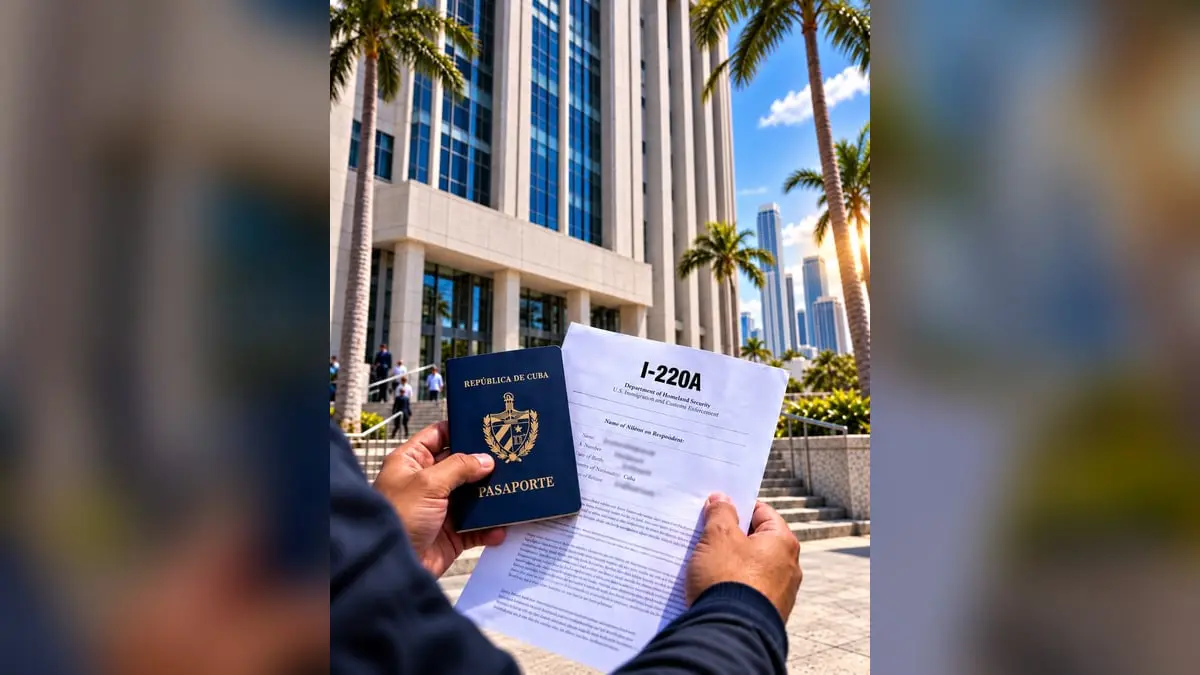
First came those who left after 1959. Then Camarioca and the Freedom Flights. Mariel followed, with 125,000 Cubans landing in the United States in 1980. Later came the rafters, the 1994 crisis, the migration accords, and the phrase that eventually entered the vocabulary of several generations: wet foot, dry foot. Each era had its boats, its airports, its borders, and its farewells. The most recent generation also has a symbol. But it is not a raft. It is not an airplane. It is a sheet of paper. At the top are three characters now heard in law offices, immigration courts, and family conversations from Miami to Texas: I-220A. For thousands of Cubans, those characters embody one of the great paradoxes of recent migration history: having managed to reach the United States while, in legal terms, still standing at the threshold. They are not newcomers in the everyday sense. Many have spent years working, paying rent, raising children, buying cars, starting small businesses, and rebuilding families. Yet in the immigration system, their stories may remain open. They have arrived. And they are still waiting to finish arriving.
A door that for decades seemed different To understand the I-220A drama, one must go back to long before the form existed. After 1959, migration between Cuba and the United States became a historical anomaly. A Congressional Research Service report notes that the Cuban exodus reached approximately 78,000 people in 1962 and that, over the following decades, hundreds of thousands of Cubans entered through special humanitarian mechanisms. In 1966, Congress enacted legislation that would forever transform the Cuban immigrant experience: the Cuban Adjustment Act. Under certain conditions, the law allows a Cuban citizen or native to apply for permanent residence after being physically present in the United States for at least one year, provided that the person meets other requirements, including having been inspected and admitted or paroled. For decades, that last condition—admitted or paroled—seemed like a technicality reserved for lawyers. Today it sits at the center of countless families’ lives. The problem facing approximately 500,000 Cubans with I-220A can be summarized in a single word: parole.
The day an era ended For more than two decades, the policy known as “wet foot, dry foot” generally allowed Cubans who managed to reach United States territory to remain in the country, while those intercepted at sea could be returned. The policy emerged from the migration realignment of the 1990s following the rafter crisis. It ended abruptly on January 12, 2017. Just eight days before leaving the White House, President Barack Obama announced its termination. From that point on, Cubans entering irregularly would generally be subject to the same immigration laws that apply to citizens of other countries. The Cuban Adjustment Act, however, did not disappear: it was a statute enacted by Congress, not the administrative policy that had just been eliminated. That legal distinction would have consequences few could imagine at the time. The door still existed. What had changed was the way to reach it.
The new stampede Decades after Mariel and the rafter crisis, Cuba once again experienced an extraordinary outflow of citizens. This time, many of the images were not of rafts crossing the Florida Straits. They showed airports, roads, buses, jungles, borders, and families crossing entire countries to reach the United States. The geography of the exodus had changed. So had the bureaucracy waiting on the other side. Some Cubans detained after entering were later released with a document called Form I-220A, Order of Release on Recognizance. To an ordinary person, the difference might seem insignificant. The individual had been detained. Processed. Released by the government. The person could report to the authorities when required. A life could begin. But in immigration law, two documents that allow two human beings to walk out of a detention center can produce entirely different legal consequences. That is where the labyrinth began.
The paper that changed a generation In September 2023, the Board of Immigration Appeals, or BIA, issued a decision that struck the community hard. The case was Matter of Cabrera-Fernandez. The Board held that release under certain provisions of immigration law—including release on recognizance—was legally distinct from parole granted under Section 212(d)(5)(A) of the Immigration and Nationality Act. In simple terms, being released did not necessarily mean being granted the kind of parole needed to satisfy that requirement of the Cuban Adjustment Act. The distinction may take up only a few lines in a ruling. In real life, it can take up years. Years without knowing whether an application for residence will succeed. Years following judges’ decisions that most immigrants never imagined they would have to learn to interpret. Years hearing terms such as parole, removal proceedings, BIA, jurisdiction, appeal, and adjustment of status. I-220A turned workers, mothers, fathers, doctors, mechanics, truck drivers, and newly arrived young people into involuntary students of United States immigration law.
The Cuban paradox Here lies one of the deepest contradictions in this history. The United States retains an extraordinary law created specifically for Cubans. Yet some Cubans already physically present in the United States cannot automatically benefit from it simply because of their nationality or because they have spent a year in the country. The Cuban Adjustment Act imposes specific requirements. Among them is having been inspected and admitted or having received the legally relevant parole. That is why I-220A should not be described, as sometimes happens on social media, simply as “residence pending.” Nor does it mean that every holder is in exactly the same situation. Cases may vary according to how entry occurred, which authority the government used to detain the person, which documents were issued, whether removal proceedings exist, whether asylum was requested, and other individual factors. It is precisely that complexity that makes the situation even more distressing. No magic phrase can resolve every case.
2026: a crack in the wall—then something important happened. On February 23, 2026, the United States Court of Appeals for the Eleventh Circuit considered the cases of two Cuban families: Labrada-Hechavarria and Castillo-Casanova. The immigrants had entered without documentation, were briefly detained by the Department of Homeland Security, and were later released. Immigration authorities had concluded that they could not adjust under the Cuban Adjustment Act because release on recognizance did not constitute the required parole. But the Eleventh Circuit vacated the BIA decisions and returned the cases for further proceedings. It was an important decision. It also began another battle: the battle against false expectations. The court did not declare that every I-220A automatically constitutes parole. It did not automatically turn all holders into permanent residents. What it did was reopen legal questions about the statutory grounds used to detain and later release those immigrants. And in immigration law, a door opening again by a few inches can sometimes mean additional years of litigation.
Six decades later, another kind of exile The first great Cuban exile carried suitcases. Mariel carried boats. The rafters carried inner tubes, wood, and anything that could float for ninety miles. The border generation carried backpacks across thousands of miles. The I-220A generation carries case files. Perhaps that will be its historical image: a folder full of documents. A court date. A pending application. An address that must be kept current. An appointment. An alien registration number. A consultation with a lawyer. A notice that can change a life. Suffering cannot be compared mathematically across generations. Every Cuban exodus had deaths, separations, losses, and shattered families. But this generation confronts a particular form of erosion: prolonged uncertainty. Not knowing. Not knowing when. Not knowing what a court will decide. Not knowing whether an interpretation will change. Not knowing whether the same document that seemed to close a door yesterday might be examined tomorrow under a different legal theory. Bureaucratic anguish has become a way of life.
Living while waiting Reducing these people to a form, however, would repeat the bureaucracy’s own mistake. Behind every I-220A is a story that does not fit inside a box. Some people arrived with children who now speak English better than Spanish. Some started over from nothing. Some work before dawn and return at night. Families have already celebrated birthdays, births, graduations, and Christmases in the United States. For them, legal time and human time move at different speeds. The case may remain open. Life does not. Children grow. Parents in Cuba grow old. Marriages begin or end. Apartments are rented. Furniture is bought. Relatives are buried without one last embrace. A whole existence is built while an essential part of the future remains written in pencil.
From “dry feet” to “uncertain papers” For years, a brutally simple phrase summed up much of Cuban migration policy: if you reached land, you had arrived. That era ended in 2017. The current generation discovered a far more complicated reality: being inside the United States does not necessarily mean the migration journey is over. That change may be one of the most profound historical transformations the Cuban exile community has experienced since 1959. For decades, Cuban exceptionalism was associated with doors unavailable to other immigrants. A legal exceptionalism remains today—the Cuban Adjustment Act is still part of United States law—but for certain migrants the debate has shifted to something far more technical: precisely how they were processed when they arrived. A person’s fate may depend on the difference between two sections of a statute. Between detention and parole. Between release and admission. Between an I-220A and another document. A family’s history may end up depending on a box on a form.
An exile community growing older while awaiting answers The history of Cuban migration to the United States has never been linear. 1959. 1966. 1980. 1994. 1995. 2017. 2021. 2023. 2026. Each date changed what the word arrival meant. Mariel showed that 125,000 people could transform a city in a matter of months. The rafter crisis forced Washington and Havana to renegotiate the rules of exodus. “Wet foot, dry foot” turned a shoreline into the border between two destinies. Obama ended that policy in 2017. And I-220A has now turned an administrative debate into one of the central migration questions facing the contemporary Cuban community.
The final border That may be why it is not enough to describe this story solely as an immigration problem. It is also a story about belonging. What does it mean to have arrived in a country? To cross its border? To work there? To raise your children there? To pay taxes? To build a home? Or to finally receive a document saying you may stay? For thousands of Cubans, these questions are no longer philosophical. They are everyday questions. For six decades, entire generations left Cuba convinced that the hardest part of the journey ended when they reached the United States. For the I-220A generation, the story has been different. They escaped an island. Crossed borders. Reached the country that for generations had represented the end of the Cuban road. And there they encountered one last border. It is not in the Florida Straits. It is not in the Rio Grande. It is not drawn on any map. It exists in court files, legal interpretations, and papers stamped by the United States government. It is a border made of paper. And while judges, lawyers, and federal agencies debate the legal meaning of the moment when they were detained and released, thousands of lives continue moving forward on the other side of that invisible border.
Sixty years after the United States enacted an extraordinary law for an extraordinary migration, a new generation of Cubans is again asking the question that has accompanied the exile community since 1959:
When does the journey truly end?
— Malecón90 Newsroom